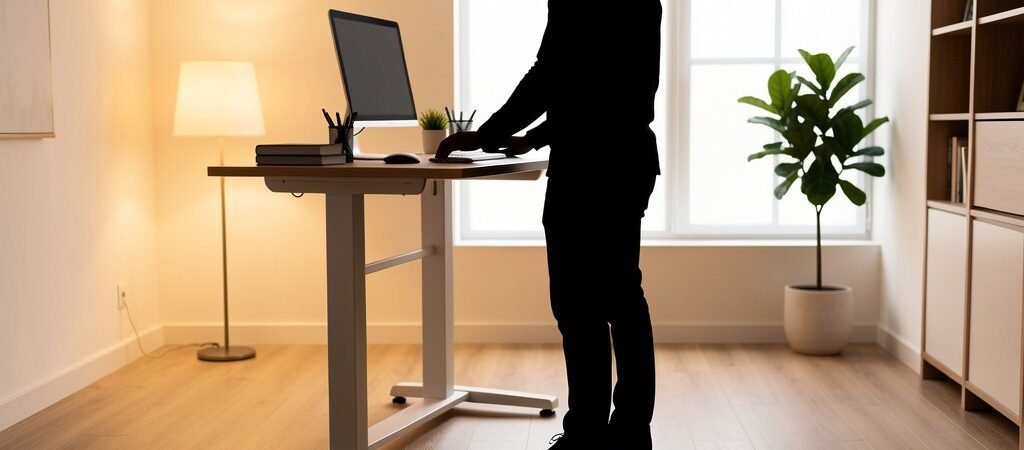
The standing desk has gone from office novelty to mainstream productivity tool in less than a decade. Walk into any well-equipped home office today and you will likely find one. But are they actually worth it — and do they genuinely improve how you work?
The answer, according to current research, is nuanced. Harvard Business Review’s coverage of physical work environment and transitions Standing desks offer real benefits — but not the ones most people expect. As explored in Harvard Business Review’s coverage of physical work environment and performance, the key variable is not standing versus sitting — it is movement and posture variation throughout the day.
What the Research Actually Shows
A 2018 study published in the British Journal of Sports Medicine followed call centre workers who switched to sit-stand desks for 12 months. The results: 53% reduction in upper back and neck pain, self-reported improvements in energy and mood, and — critically — no reduction in work performance metrics.
But here is what the same research found: standing all day is not better than sitting all day. Standing for prolonged periods creates its own set of problems — lower limb fatigue, varicose vein risk, and reduced fine motor control for tasks like precise typing or design work.
The evidence points clearly toward one conclusion: the best setup is one that makes movement easy and natural — not one that locks you into any single position for hours.
The Case for a Standing Desk
Given that caveat, standing desks offer genuine advantages for remote workers and professionals:
- Reduced afternoon energy dip — alternating between sitting and standing helps maintain alertness during the post-lunch cognitive slump
- Better posture over time — standing encourages a more neutral spine position, reducing the chronic lower back strain that accumulates with fixed seated posture
- Increased movement opportunities — having a standing option makes it easier to take micro-movement breaks without leaving your workspace
- Better for call-heavy workdays — many people find standing makes them more energetic and engaged during phone and video calls
The Case for Sticking With a Sitting Desk
A high-quality ergonomic chair at a well-set-up seated desk is a genuinely effective setup that millions of productive professionals use with excellent results:
- Better for sustained deep focus tasks — fine motor control, typing accuracy, and reading comprehension are all slightly better seated
- Lower cost — a good ergonomic chair is cheaper than a motorised standing desk
- Simpler setup — no height adjustment mechanics, no learning curve
- More comfortable for very long sessions — when you are in a genuine flow state, standing can become an unwanted physical variable
The Real Answer: A Sit-Stand Protocol
The most effective approach is intentional alternation. A practical protocol used by many remote workers:
- Sit for the first 90 minutes of deep focused work in the morning
- Stand during calls, email processing, and lighter administrative tasks
- Sit again for afternoon deep work blocks
- Stand again in the late afternoon when energy naturally dips
If you use a standing desk, set a timer or use a tool like Stretchly (free app) to remind you to alternate positions every 45–60 minutes.
Standing Desk Buying Guide
Budget Option (Under €300)
- Flexispot E2 — reliable motor, straightforward controls, solid build for the price
- IKEA BEKANT sit/stand — simple lever mechanism (not motorised), low cost, available in multiple sizes
Mid-Range (€300–€600)
- Flexispot E7 — dual motor, height memory presets, anti-collision detection, outstanding value
- Yaasa One — European brand, excellent build quality, clean minimal design
Premium (€600+)
- Uplift V2 Commercial — the benchmark for premium standing desks, industry-leading warranty, wide customisation options
- Autonomous SmartDesk Pro — excellent tech integration, programmable app control
Anti-Fatigue Mats: Non-Negotiable if You Stand
If you use a standing desk without an anti-fatigue mat, you will find standing uncomfortable within 30 minutes. A good mat makes standing genuinely sustainable for extended periods.
- Topo by Ergodriven — the industry favourite, contoured surface encourages subtle foot movement
- Amazon Basics Anti-Fatigue Mat — functional budget option, flat surface, does the job
- Flexispot MT1 — good mid-range option, grippy surface, easy to clean
Ergonomic Chair Buying Guide (For Seated Setups)
If you are committing to a seated setup, invest in your chair before anything else. Poor seating is the single highest risk factor for the physical discomfort that degrades focus over time.
- IKEA Markus — best value ergonomic chair available, good lumbar support, suitable for most body types
- Secretlab Titan — premium gaming chair that works excellently as an office chair, exceptional lumbar adjustment
- Herman Miller Aeron — the professional benchmark, expensive but worth it for full-time remote workers who sit 8+ hours daily
The Bottom Line
A standing desk is not a magic productivity device. It is a movement tool. If you use it as designed — alternating positions regularly throughout the day — it will reduce physical discomfort, help sustain afternoon energy, and support better posture over time.
If your budget is limited, a good ergonomic chair plus a habit of standing up and moving every 45 minutes achieves most of the same benefits at a fraction of the cost. The movement matters more than the furniture.